Multi-Tenant SaaS Architecture: How to Choose the Right Tenancy Model for Your MVP
Shared schema, schema per tenant or database per tenant? A practical guide to multi-tenant SaaS architecture, with trade-offs, a comparison table and a sensible default for early-stage products.

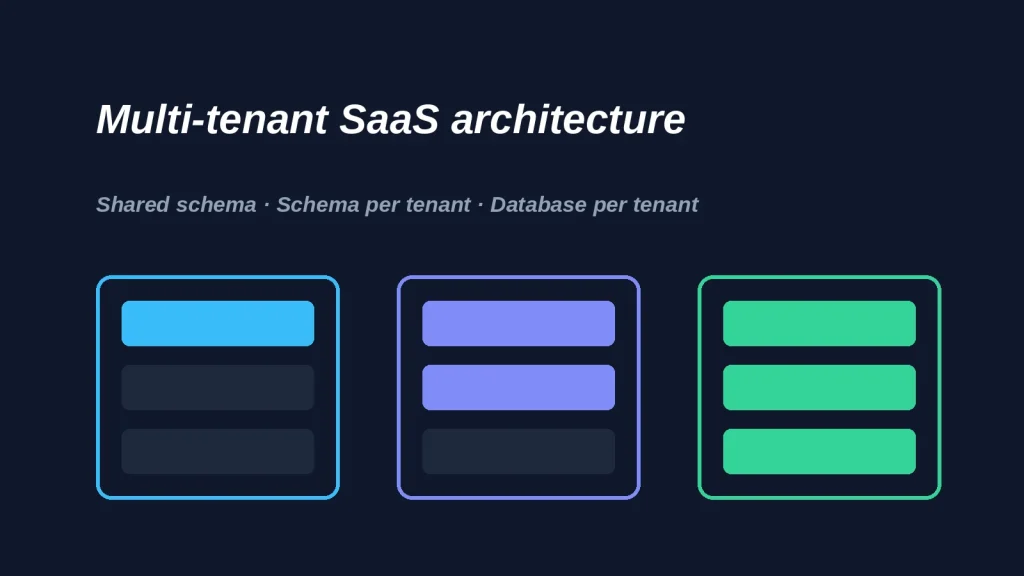
If you are building a SaaS product for more than one customer, one decision made in the first weeks will quietly shape your costs, your security posture and your ability to scale for years: how you separate one customer’s data from another’s. This is the multi-tenant SaaS architecture decision, and it is far cheaper to make deliberately than to retrofit after your first twenty customers.
This guide is for founders, product owners and CTOs planning a SaaS MVP. It explains the three common tenancy models, the trade-offs that actually matter, and a pragmatic default for early-stage products. A good multi-tenant SaaS architecture is less about clever technology and more about choosing the right level of isolation for your customers.
What “multi-tenant” actually means
A tenant is one customer organisation using your product: a clinic, a logistics company, a restaurant group. In a multi-tenant system, many tenants share the same running application. In a single-tenant system, each tenant gets its own copy of the application, its own database, or both.
Most SaaS products land somewhere between those extremes. The useful question is not “multi-tenant or not?” but “which layers do we share, and which do we isolate?” The usual layers are the application servers, the database, and the storage for files.
Three multi-tenant SaaS architecture models
Cloud providers such as AWS describe these as the silo, pool and bridge models. Here is how they look in practice.
1. Shared database, shared schema (pool)
All tenants live in the same tables, and every row carries a tenant_id. The application filters by it on every query.
- Pros: cheapest to run, simplest to deploy, one migration updates everyone, easy cross-tenant analytics for your own team.
- Cons: one missing filter can leak data between customers; a heavy tenant can slow everyone else (the “noisy neighbour” problem); per-tenant backup and restore is awkward.
2. Shared database, separate schema per tenant (bridge)
Each tenant gets its own schema inside one database. Isolation is stronger than with a shared schema, but migrations must run once per tenant, and that becomes slow and error-prone at hundreds of tenants.
3. Separate database or deployment per tenant (silo)
Each tenant has its own database, and sometimes its own application instance.
- Pros: strongest isolation, simple per-tenant backup, data residency is easy to promise, a noisy tenant cannot hurt others. Enterprise buyers often ask for this.
- Cons: highest infrastructure cost, slower onboarding unless provisioning is automated, and every release has to be rolled out across many environments.
Comparison at a glance
| Factor | Shared schema | Schema per tenant | Database per tenant |
|---|---|---|---|
| Cost per tenant | Lowest | Medium | Highest |
| Isolation | Application-enforced | Stronger | Strongest |
| Migrations | Once | Once per tenant | Once per tenant |
| Per-tenant restore | Hard | Moderate | Easy |
| Best for | Many small customers | Dozens to low hundreds | Regulated or enterprise customers |
How to choose: five questions to answer first
- Who is your customer? Hundreds of small businesses point to a shared schema. A handful of banks, hospitals or public bodies point to isolated databases.
- What are your compliance and data-residency obligations? If a contract may require that a customer’s data stays in a specific region, plan for it now. GDPR obligations in the EU make it important to know exactly where each tenant’s personal data lives and how to delete it.
- How uneven will usage be? If one tenant could be fifty times larger than the median, you need a way to move that tenant to its own resources.
- How will you bill? Per-seat, usage-based or flat plans all need tenant-level metering. Build that hook in from day one.
- How much operational capacity do you have? Silo models are powerful but demand automation. A small team without it will drown in environments.
A pragmatic multi-tenant SaaS architecture for most MVPs
For most early-stage B2B products, the sensible starting point is a shared database with a shared schema, combined with protections that make the “missing filter” mistake hard to make:
- Enforce isolation in the database, not only in code. PostgreSQL’s row-level security lets the database itself refuse to return another tenant’s rows, even if application code forgets a filter.
- Make tenant context mandatory. Resolve the tenant once per request (from the subdomain, token or session) and pass it through a single, tested layer rather than relying on every developer to remember it.
- Test for leakage. Add automated tests that log in as tenant A and try to read tenant B’s records through every endpoint.
- Keep an exit route. Design identifiers and storage paths so that one tenant can later be lifted into its own database without rewriting the product.
This “pool first, silo on demand” approach keeps the MVP cheap while leaving room to offer an isolated tier to enterprise customers later, often as a premium plan.
Common mistakes we see
- Treating tenancy as a later feature. Adding a tenant column to a mature codebase touches every query, cache key, background job and file path.
- Forgetting the non-obvious places. Caches, search indexes, queues, exports and email templates all need tenant scoping too.
- Per-tenant custom code. Branching the code for individual customers feels fast and becomes unmaintainable. Use configuration and feature flags instead.
- No tenant-level observability. If you cannot tell which tenant caused a slowdown or an error spike, you cannot support or bill them properly.
What this means for cost and timeline
Public SaaS cost guides vary enormously, from a few thousand dollars for a narrow prototype to well into six figures for a multi-role platform with integrations, billing and AI features. The spread exists because scope differs, not because anyone is wrong. Tenancy affects that scope in three ways: authentication and roles per organisation, billing and metering, and the admin tooling your own team needs. A clear tenancy decision up front removes one of the biggest sources of surprise in a quote. For a broader view of what drives price, see our guide to what actually drives app development cost, and if your product includes a client-facing area, our article on customer portal development covers scope and security.
Frequently asked questions
Is multi-tenant always cheaper than single-tenant?
Per customer, usually yes, because infrastructure is shared. But the saving can be offset if you later need to bolt on isolation or if a few large tenants require dedicated resources. Total cost depends on your customer mix.
Can I start shared and move a customer to a dedicated database later?
Yes, if you plan for it. Keeping tenant identifiers consistent across tables, files and caches makes extraction possible. Retrofitting it into a product that never considered tenancy is much harder.
Does multi-tenancy affect security certifications?
It affects how you demonstrate isolation. Auditors and enterprise buyers typically want evidence: access controls, tests, logging and clear data-deletion procedures. Database-level controls such as row-level security make that evidence easier to provide.
How many tenants before a shared schema becomes a problem?
There is no universal number. Well-indexed shared schemas serve very large tenant counts. Problems usually come from uneven tenant sizes and unscoped queries rather than the raw count.
Planning a SaaS product?
Choosing a tenancy model is one of the decisions we work through with founders before a line of production code is written. If you are weighing options for your product, explore our SaaS product build service, or contact Shkulaku to discuss your idea with our team and get an honest view of scope, architecture and timeline.
I take on a small number of projects at a time. Tell me what you are building and I will tell you honestly whether I am the right person for it.
Get in touch →Keep reading
Dobësi në kernelin Linux: Fragnesia dhe defekti TCP që duhet përditësuar tani
Dy dobësi në kernelin Linux po bëjnë lajme këtë javë: Fragnesia (CVE-2026-46300), tashmë në listën e CISA për dobësi të shfrytëzuara, dhe një defekt i ri TCP (CVE-2026-98432). Ja çfarë do të thotë secila për biznesin tuaj dhe një listë praktike përditësimi.
Linux Kernel Vulnerability Alert: Fragnesia and the TCP Flaw Server Owners Should Patch Now
Two Linux kernel flaws are in the news this week: Fragnesia (CVE-2026-46300), now on CISA's known-exploited list, and a new TCP bug (CVE-2026-98432). Here is what each one means for a business running Linux servers, and a practical patch checklist.
Njoftim sigurie nga PHP për session upload progress (CVE-2026-115560): mbajeni të çaktivizuar
Ekipi i sigurisë së PHP rekomandon session.upload_progress.enabled=0 deri në versionin e radhës, për të mbyllur një rrugë të pagjasë RCE (CVE-2026-115560). Ja kush preket realisht dhe si ta kontrolloni për dy minuta.